
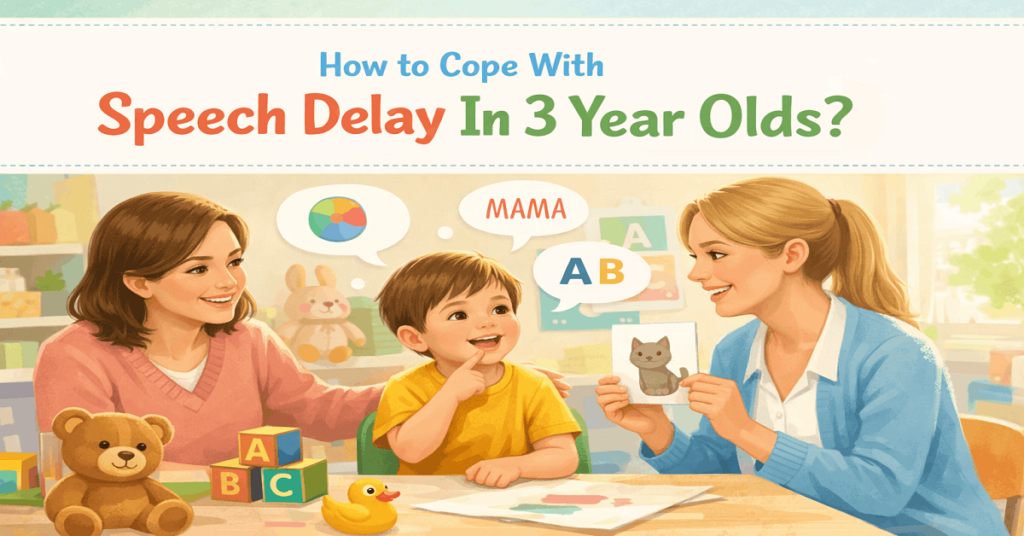
One of the happiest moments to experience for every parent is to watch their child grow and reach new milestones. However, it can also be a source of worry when things don’t seem to happen on schedule. One of the most common concerns for parents is whether their toddler’s talking is on track. Every child shows development at their own pace, but a noticeable a speech delay in a 3-year-old can sometimes indicate a need for extra support.
Early childhood is indeed a critical window for language development. When any child struggles to express their thoughts or understand others, it can affect their confidence and social skills. Hence, gaining clarity on the difference between a slight delay and a more serious condition is the first step toward receiving the right help.
What is Considered a Severe Speech Delay at Age 3?
By the time a child turns three, they are usually “little chatterboxes,” asking “why” and telling short stories. A severe delay is noted when a child is significantly behind these typical markers.
- Minimal Vocabulary: Most toddlers this age has hundreds of words, and severe delay means that the child only uses a handful of words.
- Lack of interest in Communication: If the child avoids engaging with others or may seem content to play in silence without attempting to share their experiences.
- Improper Sentence Making: If the child is avoiding saying complete sentences such as “I want juice,” and only says “juice” to get your attention, then it is a sign.
- Broken Speech: Children at the age of 3 aren’t perfect speakers, but whatever they say should be understandable about 75%.
- Regression of Speech Skills: This is one of the most serious situations when a child who used to say certain words or phrases suddenly stops using them altogether.
Reasons behind severe speech delay in 3-Year-Olds
Understanding the main causes of severe speech delay is essential for designing an effective plan.
- Hearing Problems: If a child cannot hear clearly due to infections or fluid in the ear, they cannot learn to mimic sounds and words correctly.
- Autism Spectrum Disorder (ASD): Speech delays are often one of the earliest signs of autism, usually paired with challenges in social interaction.
- Oral-Motor Issues: Sometimes the brain has trouble communicating with the muscles in the mouth, making it physically difficult to form sounds.
- Environmental Factors: A lack of verbal stimulation or high screen time can sometimes slow down language acquisition.
- Developmental Disorders: Conditions like Down Syndrome or global developmental delays can badly impact the speed at which a child learns to speak.
Key warning signs:
There are certain signs, which is the parents notice must immediately speak with a Pediatrician in Hyderabad or your local healthcare provider:
- No Imitation of Sounds or Words: The child does not try to repeat what you say or mimic animal sounds and environmental noises.
- Zero Social Engagement: Kids with speech delay usually avoid making an eye contact or responding.
- Difficulty catching instructions: If a child is unable to follow a command such as “Get your books,” chances are they are having a receptive language delay.
- Behavioral Issues: When a child is unable to express their needs, they may resort to tantrums, biting, or even screaming out of frustration.
- Poor Memory: Such children might learn a word one day but can be completely unaware the next moment.
How Severe Speech Delay is Diagnosed?
Getting a diagnosis is not about labeling your child; it is about finding the keys to unlock their potential.
- Comprehensive Developmental Assessment: A doctor looks at the child’s overall growth, including physical, social, and emotional skills.
- Hearing Exams: Here, an expert audiologist checks for hearing loss to find any blockages that might be interfering with the exposed sound.
- Speech Evaluation: Under this, evaluation is done by a specialist who would observe how your child uses gestures, follows directions, and attempts to speak.
- Medical examinations: Blood tests, and some neurological checks are necessary to rule out certain underlying medical conditions.
Best Treatments for Extreme Speech Delay
The good news is that speech delay treatment is very effective, especially when started early.
- Speech Therapy for Toddlers: Professional therapists use play-based activities to encourage sound production and vocabulary building.
- Parent Coaching: Therapists teach parents specific ways to talk and play at home to stimulate language.
- Early Intervention Programs: These are state or local programs designed to provide support services to children before they start school.
- Occupational Therapy: If the delay is linked to sensory or motor issues, an occupational therapist can help strengthen the necessary skills.
- Assistive Communication Devices: For non-verbal children, tablets or picture boards can help them communicate while they work on their verbal skills.
Best strategies for parents to support children with severe speech delay
You are your child’s best teacher. You can help your child every day by following these tips:
- Talk Frequently and Clearly: Always narrate your actions in detail to the child, such as, “I am washing the red apple,” as this gives them a constant stream of language to absorb.
- Read Together Daily: Books with bright pictures and repetitive text are perfect for building word recognition.
- Try to make easy sentences: In situations where you find the child pointing at water, ask in full sentences whether the child wants water? Such elaborate phrases help children to expand their thoughts well.
- Encourage Choices: Ask, “Do you want the blue shirt or the yellow shirt?” This forces them to try to use a word or gesture to make a choice.
- Be Patient and Celebrate Small Wins: Every new sound or attempted word is a victory. Positive reinforcement goes a long way.
When to look for professional help?
Professional help is necessary if:
- By age 3, your child speaks fewer than 50 words.
- Speech is not understandable to family members or frequent caregivers.
- Your child is frustrated due to communication challenges.
- There are signs of social withdrawal or a lack of interest in interaction.
- Regression in language functioning occurs after previously achieving milestones.
Frequently Asked Questions
Q1. How many words should a 3-year-old typically say?
Ans. Most children this age have a vocabulary of 200 to 300 words. They should also be able to string together three-word sentences, such as “Mommy goes to the store.”
Q2. Can speech therapy really help a 3-year-old catch up?
Ans. Yes! Infact, many children have shown an incredible progress through consistent therapy. They were able to catch up to their peers by the time they start kindergarten.
Q3. Does a speech delay always mean a child has autism?
Ans. No. While it can be a symptom, many children have speech delays due to hearing issues, motor delays, or simply needing more specialized stimulation.
Q4. What activities can help to improve speech?
Ans. Singing rhymes and songs, playing “I Spy,” reading interactive books, and even by limiting screen time are all great ways to boost communication.
Q5. At what point should I insist on a referral to a speech therapist?
Ans. If your child has said fewer than 50 words by age of three or cannot follow even the most simple directions, it is recommended to get a referral on an immediate basis.
Is your child struggling to find their words?
Early support can change everything. Book a consultation.with G.M. Clinic today to get an expert assessment and a personalized path forward for your child.

Dr. GM Irfan is a senior Pediatric and Laparoscopic Surgeon with 20+ years of experience in advanced surgical care for infants and children. He is a Gold Medalist in MCh (Paediatric Surgery), & holds MRCS (Edinburgh) and specialized training from IRCAD France.